

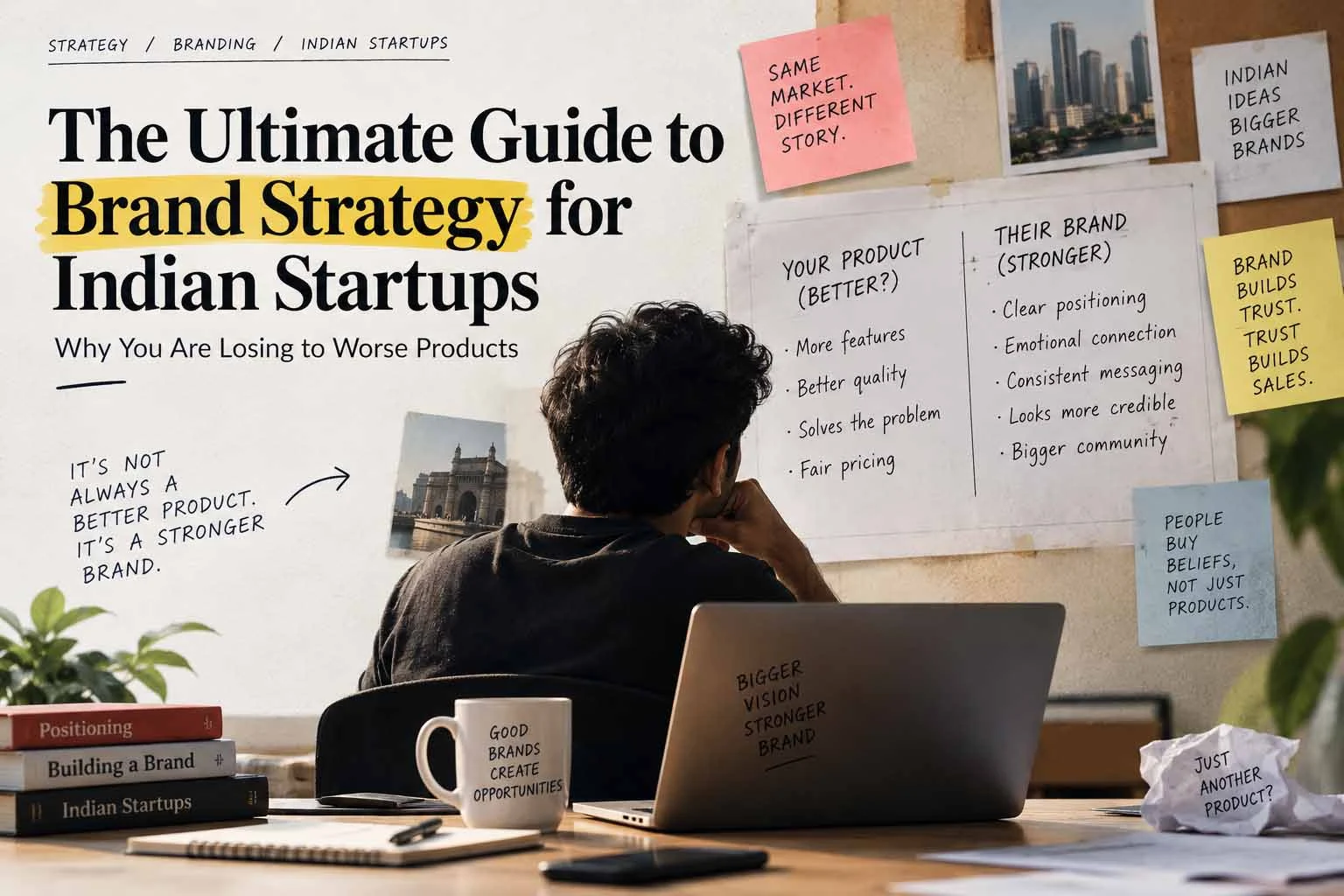
If you are a founder building a startup in India, you are probably fighting a daily war on three fronts: lowering your customer acquisition cost (CAC), preventing churn, and stopping competitors from stealing your market share.
You probably have a fantastic product. In fact, your product might be objectively better than the market leader's. Yet, every month, you watch potential clients choose your competitor—a competitor with a clunky UI, worse customer service, and a higher price tag.
Why? Because your competitor doesn't have a better product. They have a better brand strategy.
As a Brand Strategist in Kerala working with scaling startups and enterprises across India, I see the same fatal mistake repeated daily: Founders confuse marketing with branding. They pour lakhs of rupees into Facebook and Google Ads, only to realize that buying attention doesn't mean buying trust.
This guide will break down exactly what a brand strategy is, why Indian startups are failing without one, and how you can build an irreplaceable brand identity that drives sustainable revenue.
1. Marketing vs. Branding: The Fatal Misunderstanding
Let's clear this up immediately because it is the root cause of 90% of startup failures.
Marketing is how you ask for a date. (Facebook ads, SEO, billboards, cold emails).
Branding is the reason they say yes. (Your reputation, your messaging, your visual identity, your unique promise).
If your startup is running performance marketing campaigns without a solidified brand strategy, you are essentially walking up to strangers and yelling, "Buy my product!" It is exhausting, expensive, and yields terrible conversion rates.
A strong brand strategy lowers your CAC because it pre-sells your customer. When your target audience already understands who you are, what you stand for, and why you are different, your marketing doesn't have to work nearly as hard.
2. The 3 Pillars of a High-Converting Brand Strategy
If you want to stop competing on price and start commanding a premium, your brand strategy needs to nail these three pillars.
Pillar 1: The "Intersection" Positioning
Most startups try to be everything to everyone. They want to sell to Gen-Z students and corporate executives simultaneously. This is the fastest way to become irrelevant.
In my consulting practice, I use The Intersection Framework. True competitive advantage isn't found in a single feature; it is found at the intersection of your unique industry expertise, your specific cultural worldview, and the deepest unspoken pain point of your customer.
- Example: You aren't just an "accounting software." You are "financial clarity for bootstrapped SaaS founders who hate math." When you own an intersection, you eliminate competition.
Pillar 2: The Core Enemy
Every great brand needs an enemy. I don't mean a direct competitor; I mean an ideology or an old way of doing things that you are fighting against.
- Apple’s Enemy: Conformity and complexity.
- Tesla’s Enemy: Fossil fuels and slow legacy automakers. When your startup clearly defines what it is fighting against, you instantly attract customers who share your frustration. Your brand becomes a movement, not just a commodity.
Pillar 3: Visual & Verbal Consistency
Your brand identity must be brutally consistent. If your website looks like a premium enterprise solution (sleek, minimalist, dark mode), but your sales team talks like high-pressure used-car salesmen, your brand is fractured. Trust is broken.
From your logo and typography to your onboarding emails and customer support scripts, every single touchpoint must reinforce your Intersection Positioning.
3. How to Know if You Need a Brand Strategist
Founders often ask me, "Jeevan, at what stage should we hire a brand strategist?"
You don't need a brand strategist when you are testing your MVP. You need one when you are ready to scale, but you're hitting friction.
Here are the warning signs that you have a brand identity problem:
- You are stuck competing on price. If your prospects constantly ask for discounts, they don't understand your unique value. They see you as a commodity.
- Your sales cycle is painfully long. If it takes months to close a deal because you have to constantly explain why you are different, your brand messaging is failing.
- Your team can't explain what you do. If you ask 5 employees what your company does and get 5 different answers, your internal brand clarity is broken.
- High CAC, Low LTV. You are spending a fortune to acquire a customer, but they leave after a month because the reality of the product didn't match the promise of the marketing.
4. The Blueprint: Fixing Your Brand Today
If you are a founder in Kerala or anywhere in India, here is the immediate action plan you can implement this week:
- Kill the Jargon: Rewrite your website's headline. Remove words like "synergy," "disruptive," and "blockchain-enabled." Explain exactly what pain you solve for exactly who, in plain English.
- Audit Your Touchpoints: Go through your own customer journey. Read your automated emails. Look at your invoices. Does it feel like a premium brand experience, or does it feel like a chaotic startup?
- Define Your Non-Negotiables: Write down 3 things your company will never do, even if it costs you money. (e.g., "We will never sell customer data," or "We will never use chatbots for support"). Communicate these publicly.
The Bottom Line
A great product without a brand strategy is a well-kept secret. A great marketing campaign without a brand strategy is a fast track to bankruptcy.
You must align your internal clarity with your external messaging. When you do that, scaling stops being a struggle and starts becoming a natural byproduct of your brand's gravity.
Ready to find out why your startup is facing friction? Before you spend another rupee on Facebook ads, you need to know exactly where your brand is leaking trust.
👉 Take the 2-Minute Growth Clarity Diagnostic to find out if your business is suffering from a marketing problem or a brand clarity problem.